Welcome to DU!
The truly grassroots left-of-center political community where regular people, not algorithms, drive the discussions and set the standards.
Join the community:
Create a free account
Support DU (and get rid of ads!):
Become a Star Member
Latest Breaking News
Editorials & Other Articles
General Discussion
The DU Lounge
All Forums
Issue Forums
Culture Forums
Alliance Forums
Region Forums
Support Forums
Help & Search
Science
Related: About this forum
Scientists mapped the shape of a supernova for the first time ever - and it's not what we expected: Space photo of the w
Scientists mapped the shape of a supernova for the first time ever – and it's not what we expected: Space photo of the weekBy Shreejaya Karantha
published 14 hours ago
Astronomers using data from the Very Large Telescope (VLT) have revealed that the initial "breakout" phase of a supernova is elongated, not perfectly spherical.
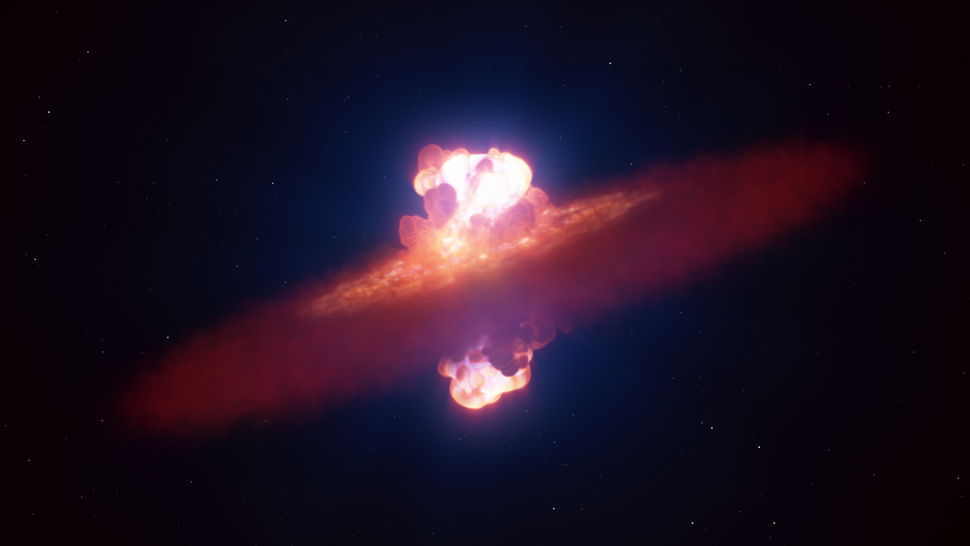
An artist's impression of a supernova "breakout." New observations reveal that dying stars don't explode in perfect spheres, as previously thought. (Image credit: ESO/L. Calçada)
On April 10, 2024, the Asteroid Terrestrial-impact Last Alert System (ATLAS) detected first light from an explosion of a massive star with roughly 12 to 15 times the sun’s mass. Just 26 hours later, astronomers pointed the Very Large Telescope (VLT) in Chile at the supernova, as this early and brief window provided a rare opportunity to study the initial phase of a star’s death.
The stunning image is an artist's interpretation, showcasing the supernova explosion as revealed by the VLT data. Thanks to some quick observations, astronomers were able to detect the explosion’s shape during its earliest moments — a phase that would not have been seen if observed just one day later.
Known as SN 2024ggi, this supernova explosion took place in the galaxy NGC 3621, which is located approximately 22 million light-years away in the constellation Hydra. An image captured by the VLT on April 11, 2024 shows the location of this explosion within the galaxy.
On April 10, 2024, the Asteroid Terrestrial-impact Last Alert System (ATLAS) detected first light from an explosion of a massive star with roughly 12 to 15 times the sun’s mass. Just 26 hours later, astronomers pointed the Very Large Telescope (VLT) in Chile at the supernova, as this early and brief window provided a rare opportunity to study the initial phase of a star’s death.
The stunning image is an artist's interpretation, showcasing the supernova explosion as revealed by the VLT data. Thanks to some quick observations, astronomers were able to detect the explosion’s shape during its earliest moments — a phase that would not have been seen if observed just one day later.
A massive star maintains its near-perfect spherical shape due to a delicate balance between the inward pull of its own gravity, and the outward force of the nuclear fusion-powered radiation generated at its center. When this balance is lost, the star dies — gravity finally overpowers the pressure holding its core up, causing it to collapse under its own weight.
More:
https://www.removepaywall.com/search?url=https://www.livescience.com/space/scientists-mapped-the-shape-of-a-supernova-for-the-first-time-ever-and-its-not-what-we-expected-space-photo-of-the-week?utm_medium=referral
4 replies
 = new reply since forum marked as read
Highlight:
NoneDon't highlight anything
5 newestHighlight 5 most recent replies
= new reply since forum marked as read
Highlight:
NoneDon't highlight anything
5 newestHighlight 5 most recent replies
= new reply since forum marked as read
Highlight:
NoneDon't highlight anything
5 newestHighlight 5 most recent replies
Scientists mapped the shape of a supernova for the first time ever - and it's not what we expected: Space photo of the w (Original Post)
Judi Lynn
Yesterday
OP

SWBTATTReg
(25,910 posts)1. Wow. Nice and thanks! Capturing the exact moments of a beginning supernova is rare, being that folks don't catch it in
time until the last moments of the nova come into play, and finally reaches telescopes on Earth. Nice, nice, nice!!

AllaN01Bear
(28,219 posts)2. BURP, no, ultra mega BURP

Justice matters.
(9,170 posts)3. Wow. Given the distance its light reached the telescope...
It's interesting to note that the huge star explosion happened some time ago (it's not a "real time" event).

Staph
(6,446 posts)4. It looks like the explosion of the Death Star
in the original Star Wars movie. Well, the Special Edition version, where they added the exploding ring.