Environment & Energy
Related: About this forumIs there enough copper on Earth for China's so called "Energy Transition?"
The paper I'll discuss in this post is this one: Binbin Li, Liang Wang, Ling Zhang, Huijun Wu, Zengwei Yuan, Navigating copper demand-supply dynamics for China's energy transition: Pathways to sustainable supply, Energy, Volume 330, 2025, 136913
Here at DU we hear a lot about so called "green" energy in China, the country with over 1000 coal powered electricity plants, a country that makes most of its industrial hydrogen by the steam reformation of coal, but also is the largest producer and user of solar cells and wind turbines.
It is also the largest by far builder of nuclear plants, and before this decade is out, will displace the United States as the largest producer of nuclear energy.
As far as energy goes, China is a case of "Everything all at once," just like the hyperkinetic movie with the same title.
Coal plants and nuclear plants are something that solar and wind plants are not, reliable. If one has solar and wind plants one must have redundant systems - there's lots of bullshit flying around about batteries and worse, hydrogen - but the reality is that solar and wind plants are backed up, in China, by coal. The use of hydrogen to back up solar and wind plants makes the use of coal worse, since the steam reformation of coal (using coal generated heat) since the laws of thermodynamics require that transforming coal into hydrogen destroys exergy, exergy being the term for recoverable usable energy. There is not in China, or for that matter anywhere else on Earth, enough excess so called "renewable energy" to justify industrial scale electrolytic hydrogen plants, nor is enough matter on Earth to justify mountains of batteries to back up so called "renewable energy."
So called "renewable energy" is not sustainable because of its enormous land demands, but more importantly, its material demands. It is the material demands that make the term "renewable" in the term, a joke, not a very funny one either.
The graphics in the paper cited indicate something about the unsustainable material demands of so called "renewable energy" and I'll produce a few.
First, from the introductory text of the paper:
As global warming intensifies, international efforts such as the Paris Agreement have called for collective action to limit temperature rise and promote low-carbon practices worldwide [1]. In this context, accelerating the energy system transition has emerged as a crucial strategy for countries to combat climate change and achieve sustainable development [2,3]. This transition encompasses not only the development of new energy sources, such as renewable energy like solar, wind, hydro, and nuclear power technologies, but also innovative methods of energy utilization, exemplified by electric vehicles, battery energy storage, and hydrogen energy technologies, etc. [4]. In this domain, copper is an indispensable raw material due to its excellent electrical and thermal conductivity. It is extensively utilized in vital energy transition equipment and technologies, including solar cells, wind power generation systems, and electric vehicles, playing a vital role in the energy transition.
The power and transport sectors, as pivotal components in the energy transition, will see an increasing demand for copper as core technologies for new energy sources mature and are gradually implemented [5,6]. However, this growing demand is met with the challenge of depleting copper reserves and intensifying pressure on copper supply [7]. The sustainable supply of copper is complex. On one hand, the extraction and processing of copper are constrained by geological conditions and environmental policies. On the other hand, advancements in recycling technologies can critically enhance the utilization and supply of secondary copper resources [8,9], profoundly affecting the copper metabolism pattern. Several studies have examined the effects of clean energy generation technologies and electric vehicle deployment on global copper metabolism [10,11]. For instance, Kalt et al. projected global metal demand from the power sector through 2050 [12], Habib et al. revealed critical metals supply risks associated with large-scale EV deployment [13], and Watari et al. simulated copper metabolism trajectories under carbon budget constraints [14]. These studies provide essential data to support a comprehensive analysis of copper metabolism in the low-carbon energy transition...
I like the word "metabolism" used in this context. Copper is, by the way, an essential element in living systems, many important enzymes require it, however it is one of those elements, like, say, selenium, that essential in some concentrations, toxic in excess.
Industrial metabolism is something quite different. Because of copper's excellent electrical conductivity, exceeded only by silver and gold, its rarer congeners, it plays an important role in all industrial systems involving electricity, notably in generators and transmission lines.
Now about a term often thrown around these days which is in my view, a nonsense term: "Energy transition." It appears nine times in just this short amount of text. There is no "energy transition." We are using more fossil fuels than ever before and the use is rising not falling. This paper delineates the limits.
Further on in the text, not much further, the source of the largest concern is identified:
I added the bold.
All of the bolded words are popular among our "renewable energy will save us" types, who, by the way, have little or no concern about fossil fuels. They call the bolded terms "green." (Well if one must know, copper salts, oxides and sulfides in the most common oxidation state, 2+, are green, but that's about where it ends.) Why mention only these cases? Because they function only for small portions of any given day. Wind power, solar power, and the use of vehicles are intermittent, for the majority of the time all of the copper in them is stranded copper, doing nothing useful for humanity. This is also true of the wires connecting the redundant systems, which despite all the battery and hydrogen bullshit that flies around, are in China, as is the case everywhere else on the planet, fossil fuel systems. Moreover, if a coal plant is shut for a few hours because the wind is blowing and the sun is shining, the copper contained in that plant is stranded copper.
The paper identifies four sources of what they - not I - call "clean" energy: Solar, Wind, Hydro and Nuclear. Only one of these forms is both reliable and infinitely expandable. Only one exhibits the energy density to minimize disruption to the natural world. That's nuclear. It's nice to see, in the literature the recognition, which should have always been obvious, but often ignored for reasons that can only be social, not at all connected with reality, that nuclear is a clean form of energy; it is in fact the cleanest of all.
There is a lot of discussion in this rather long paper of copper flows, including some relying on the time to obsolescence with an assumption that systems that have failed will be recycled, a somewhat dubious assumption in my view. Wind and solar junk has short lifetimes before requiring replacement, but the distribution of the junk is by its very nature diffuse. It takes energy and careful attention to collect it, transport it, dismantle it, isolate the components. The more mass that is involved, the more diffuse the distribution of materials the more energetically intense the recycling requirements, and...this is important, the percentage - which will never be 100% recovered.
Let me get personal, and discuss my own moral failings:
One can recognize this oneself if one is, as I am, sufficiently bourgeois and is in possession of small devices containing copper, and can, in fact extend this to other elements. I have two electric chainsaws, for example, one that was corded and run by copper containing extension cords, and one that is battery powered - the brand being an Ego chainsaw which uses cobalt/nickel/manganese type lithium ion batteries. One of the five Ego batteries I have, one for the chainsaw, two for the snow blower, one for the lawn mower, there is one that failed and was replaced under warranty. When I called for the warranty the nice woman there told me to bring the failed battery back to the store. I mean to do it, I really do, but well, I keep not getting around to it. I have no idea where I might take the corded chainsaw to recycle it to recover the copper in it. So it sits, with its sequestered copper in my garage, useless to serve humanity, unless I find the time and the energy involved in driving my car to some place where further energy might be spent to dismantle it and sort through whatever valuable materials it may contain, and discard those that are not worth recovering.
My Ego batteries contain conflict metals, mined by slaves or near slaves in Africa, and I know all about that, but am morally insufficient to do something about it, that is, drive my hybrid car with its conflict metal batteries back to the store to recycle the battery.
I'm sure I'm not alone in this bourgeois behavior.
Let's return to the paper, a nice paper, and China and copper.
The paper offers graphics demonstrating how copper is distributed among uses, and it informs, in my view everything one needs to know about how copper is utilized in China.
The first, a (simpler) KEGG type schematic of "copper metabolism" in China:
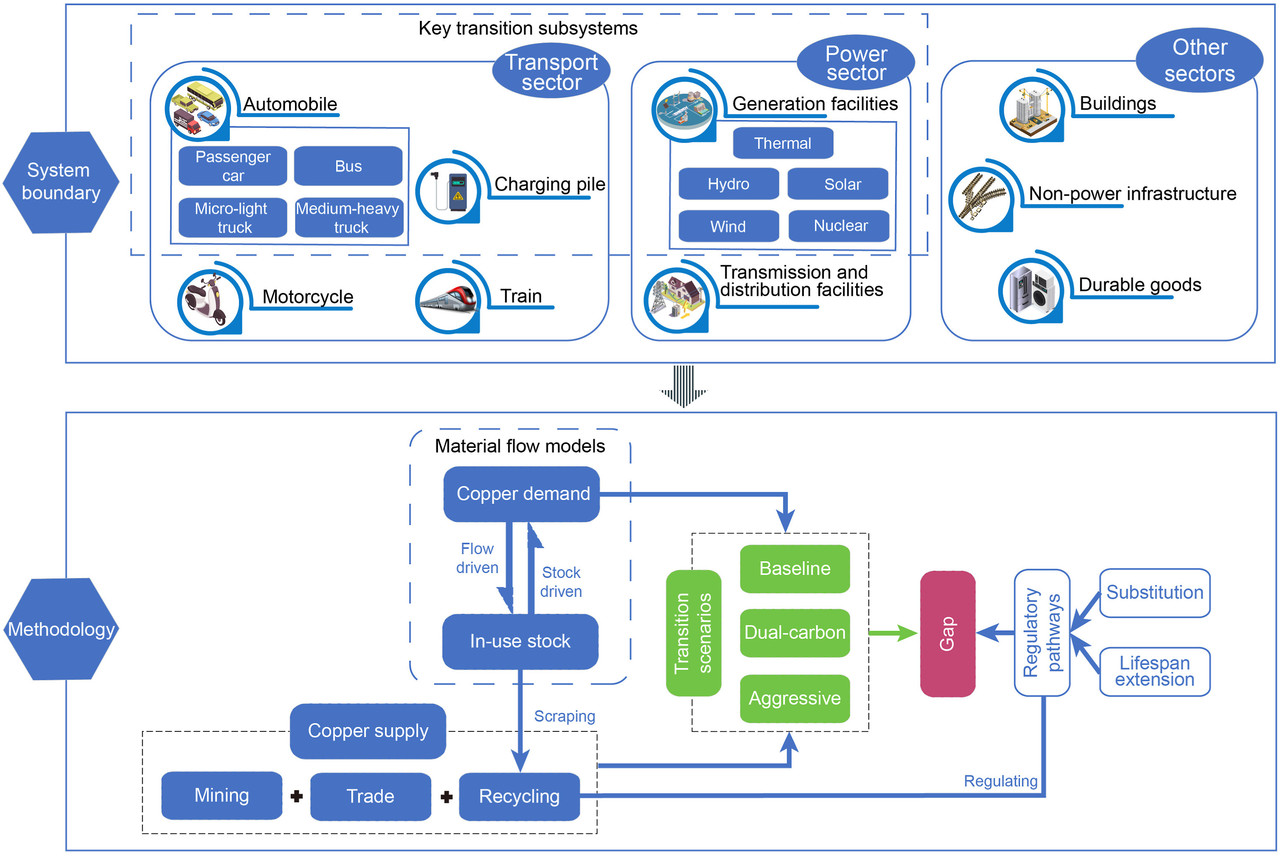
The caption:
Note: Key subsystems refer specifically to those involved in the energy transition. In the transport sector, they include conventional vehicles, new energy vehicles, and charging piles, excluding trains and motorcycles. In the power sector, they include thermal, hydro, wind, solar, and nuclear power generation facilities, but exclude transmission and distribution infrastructure.
Note the transmission exclusion.
The second, most critical is the apportioning of copper to the various systems it supports:
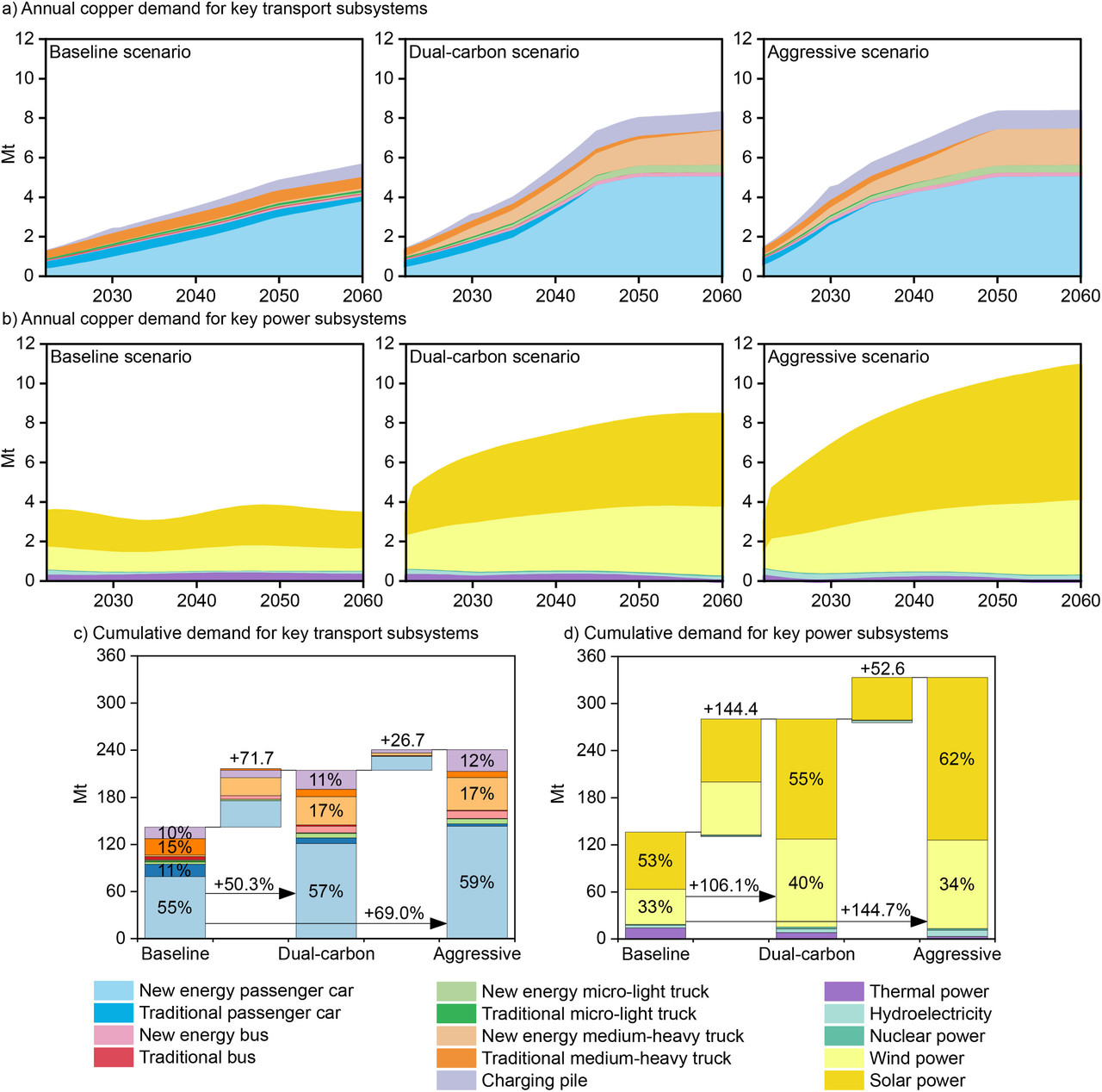
The caption:
Note: Subfigures a and b represent the annual copper scrap from key subsystems in transport and power sectors, respectively, under three transition scenarios. Subfigures c and d represent the cumulative copper scrap from key subsystems in transport and power sectors, respectively, under the three transition scenarios.
It behooves me to define the "three scenarios," scenarios being an element of soothsaying that all of our antinukes and "I'm not an antinuke" types love to wax romantic about with all their "by 2040," "by 2050" and so on wishful thinking.
From the text of the paper, the baseline scenario:
...and...
...and...
In each excerpt I have added the bold.
Note than it none of the "scenarios" does nuclear energy appear as a major driver of copper demand, not because China does not have, and will not have nuclear plants, but rather because the nuclear plants, unlike the solar and wind junk, are mass efficient. One does not need a vast array of wires to connect systems that operate less than 30% - in the case of solar way less than 30% of the time, and at the same time, connect them to redundant systems. For 70% of the time, all of the copper is as useless as the copper in my disused corded chainsaw about which do not know I might have the copper recovered. Nuclear plants are mass efficient, solar and wind facilities are not mass efficient.
As I frequently point out, the Diablo Canyon nuclear plant in California produces, routinely, on a foot print of less than 12 acres, with only a few transmission lines connecting it to California's major grids, almost as much energy as all the wind turbines in that benighted State spread over hundreds, perhaps thousands of square miles, lacing connecting wires all over the State, with - when the wind isn't blowing - as useless as the copper in the abandoned chain saw in my garage.
In 2024, all the wind turbines in the State of California produced 15,781 GWh (56.7 Petajoules) of electricity, the two reactors at the single nuclear plant in California at Diablo Canyon, 18,379 GWh, (66.2 Petajoules).
Now, I have recently been referring to the book I am not finding as much time to read as I might like to do, a book written by an investigative journalist:
The Elements of Power
Subtitle:
The parts I have read refer to the (literally) green ore of copper found in the Katanga area of central Africa where appalling conditions exist for the people who have to mine that ore, along with the Coltan (niobium and tantalum) and cobalt ores found in the region.
Copper is a conflict metal. There is a moral cost of copper quite independent of its environmental and economic cost and the cost of its depletion for future generations, itself another facet of the moral cost.
Oxidized copper, which in general cannot be recovered by recycling is "green" in the literal sense of the word. The use of copper to engage fantasies about so called "renewable energy" - the metaphoric sense - is hardly "green," It is, in fact, an obscene injustice, not even to the slaves or near slaves who mine it in Africa, and even the well paid miners elsewhere, but to all future generations.
Wind power and solar power have done nothing, zero, zilch, zip to eliminate the use of fossil fuels, which continues to increase, destroying the planetary atmosphere.
This last statement calls into question what the authors define as "clean energy" in this excerpt from their conclusion to their paper:
The application of clean energy technologies is poised to dramatically reshape the overall copper metabolism in China. The combined share of the transport and power sectors in total copper demand is expected to rise from the current 61.9 % to 67.3 %−77.5 % varied across the three scenarios, underscoring their role as the primary drivers of copper demand during the energy transition.
"Clean" for whom?
I would suggest that the case presented in this paper, were one to really seriously reflect upon it, indicates that these sources of energy, short lived, mass and wilderness intensive objects of so much wishful thinking, never will, because they never can. There is not enough metal on the planet to make it so, and the moral, environmental and economic cost of metal suggests that material efficiency is a critical path for critical materials, much discussed in the literature outside of the mainstream handwaving and wishful thinking.
Nuclear energy is not risk free, nor will it ever be. It doesn't need to be risk free to be lower risk than everything else; it only needs to be lower risk. Nuclear energy is not without environmental impact. It does not need to be without environmental impact to have lower environmental impact than everything else. Nuclear energy is not devoid of material demands, but it doesn't need to be devoid of material demands to be vastly superior to everything else in this regard.
Neither its risks nor its environmental impact should be held as a special case devoid of comparison to all other options. We are well beyond the "crossroads" that may have existed with respect to our energy choices, but it may be time, albeit definitely too late, to reverse course to go back to the fork in the road and choose the wiser, safer, and cleaner pathway we did not choose before.
I hope your Memorial Day weekend was an enjoyable one.
 = new reply since forum marked as read
Highlight:
NoneDon't highlight anything
5 newestHighlight 5 most recent replies
= new reply since forum marked as read
Highlight:
NoneDon't highlight anything
5 newestHighlight 5 most recent replies

littlemissmartypants
(34,585 posts)
John ONeill
(95 posts)I've heard that a large percentage of the world's silver, too, is now used in making solar panels. Reminds me of when the Manhattan Project commandeered the entire US stock of silver bullion, because copper was needed for the war effort - but the many tons of silver was returned, later, fully accounted for, with losses of only a few ounces.
Any possibility of graphite, or even more exotic superconductors, standing in for some of copper's functions? I know one of the three science Nobels awarded to New Zealanders was for work on conductive plastics. (The other two were for Maurice Wilkins, with Crick and Watson, for the DNA double helix, and Rutherford, for his work on the nucleus. Rather ironic, since the country has effectively banned both nuclear power and genetic engineering, for agriculture at least.)

NNadir
(38,621 posts)...element. There is an error in the OP by the way saying that gold is more conductive than copper. Gold is the third most conductive element after silver and copper.
Aluminum, an Earth abundant element is sufficiently conductive to replace copper in many applications; however there in an energy penalty for doing so.
I am aware of conductive plastics and have attended a few lectures in the topic, albeit long ago. Polythiophenes, are famous examples, with conductivity bring a function of metal doping. They are not as conductive as copper I believe but certainly usable in esoteric settings. They've been known for a very long time.
I toured Oak Ridge when my son interned there as an undergraduate. They had a few calutrons on display in a museum type settings. It is true that they borrowed silver from Fort Knox to make them. Until that tour I'd always assumed that the 235U was separated by gaseous diffusion a K25. This is not true. K25 was not able to produce highly enriched uranium until after the war. The separation was performed by the Urey/Lawrence collaboration with some feed material provided with low enriched gaseous diffusion products.
As I indicated in the OP without enough copper, so called "renewable energy" cannot expand to the scale of human energy demand, given the long periods on which copper is essentially stranded either in the generation system or the backup system. Reliability has serious implications with respect to mass intensity, adding to the many reasons that nuclear energy is the only sustainable primary energy source.
I note that any Tokamak or Stellarator type system will require helium for superconductive magnets. The world is already facing a helium crisis. It's separated from methane at methane mines. The only alternative, which is still pie in the sky, is machinable superconducting ceramics. That isn't going to happen in the near term.
Fusion reactors of course make helium, but on a scale of a few grams a day. Curium and americium emit helium but again, too slowly to matter.
The worst and most idiotic nuclear energy ban is of course in the country where fission was discovered using an explanation offered by a refugee from that country. New Zealand has nothing on that coal dependent environmental hellhole Germany.
Thanks, as always, for your comment.

OKIsItJustMe
(22,201 posts)Copper Reserves and Resources
The future availability of minerals is based on the concept of reserves and resources. Reserves are deposits that have been discovered, evaluated and assessed to be profitable. Resources are far larger and include reserves, discovered deposits that are potentially profitable and undiscovered deposits predicted based on preliminary geological surveys. Copper is naturally present in the Earth’s crust.
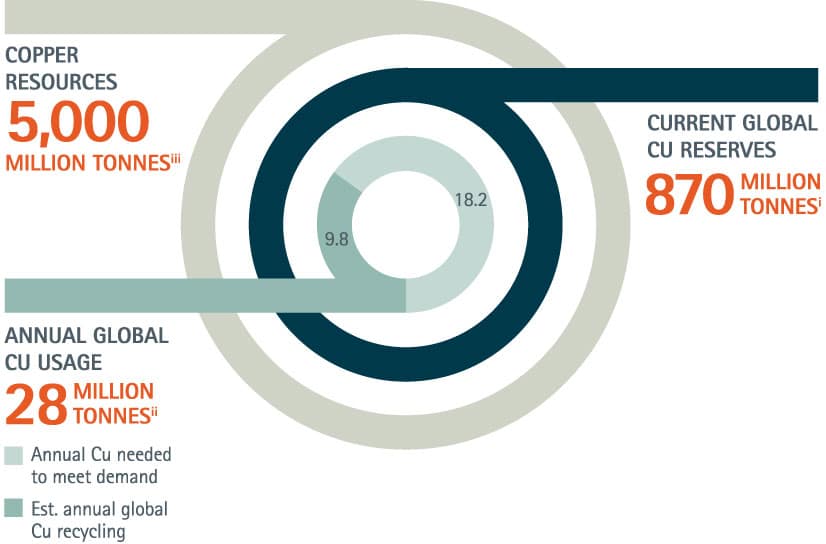
Global copper reserves are estimated at 870 million tonnes (United States Geological Survey [USGS], 2020), and annual copper demand is 28 million tonnes. Current copper resources are estimated to exceed 5,000 million tonnes (USGS, 2014 & 2017).
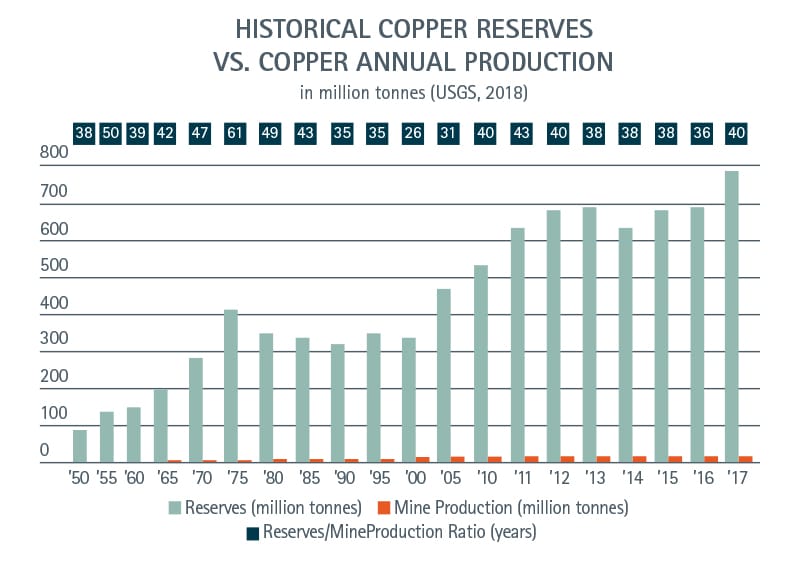
According to USGS data, since 1950 there has always been, on average, 40 years of copper reserves and over 200 years of resources left.
INNOVATION IN COPPER RECYCLING AND MINING
Copper recycling plays an important role in copper availability since today’s primary copper is tomorrow’s recycled material. The recovery and recycling of copper also helps to satisfy increasing demand and to build a sustainable future for future generations.
During the last decade, more than 30 percent of global copper demand was met with recycled copper. Future innovative policies and technologies should continue to contribute to resource efficiency in mining “primary” copper and recycling “secondary” copper.
VIEW OR DOWNLOAD FULL INFOGRAPHIC
…
NNadir
(38,621 posts)...generations.
We should be sure to hand out lots of graphics about all the wilderness we can trash for solar and wind industrial plants because we're just SWIMMING in copper!!!!!!!
Every time, I point out to an antinuke or an "I'm not an antinuke" antinuke the environmental material cost of their antinuke fantasies, they come at me with "NO PROBLEM!!! LIAR!!!! LIAR!!! PANTS ON FIRE!!!"
This happened a few years back with a real honest to Yahweh or Allah antinuke when I spoke about the limits on indium availability.
My wife and I attended an event with the producers of the movie Unearth by two fishing brothers trying to protect a salmon producing reserve in Alaska. They won when Joe Biden was President.
The first screening will be followed by a Q&A with co-directors and film subjects Auberin Strickland and Dune Strickland, director, producer, and cinematographer John Hunter Nolan, producer and impact producer Gina Papabeis, and film subjects AlexAnna Salmon and Christina Salmon. The second screening will be followed by a Q&A with John Hunter Nolan, Gina Papabeis, and producer Eyal Levy.
All in-person screening venues provide sound amplification headphones upon request with venue management. IFC Center can also provide a T-Coil loop for compatible devices.
They're sure to lose now. Bristol Bay will be replaced by a huge hole, declared "green."
One of the cool things the Strickland Brothers got on video, included in the film, was the owners of the mining company telling everyone about how great the mines would be for so called "renewable energy."
Consider me unimpressed with the graphs and charts. I'm an environmentalist of the type who believes we should do everything in our power to protect wilderness, not mine the fuck out of it and industrialize it.
That is why I support nuclear energy. It's mass and land efficient, and it need not depend on fossil fuels. It's every thing solar and wind junk isn't and can never be, sustainable, protective of wilderness, clean, and minimized against all other systems for dependence on fossil fuels.
Got it?
No?
Why am I not surprised?
Of course, the antinukes have won their case, and what a prize to show for it: Holes, fires, droughts alternating with extreme floods, on and on and on.
I'd advise anyone who gives a shit to watch the film. If one doesn't give a shit, one can always post charts and graphs about the world's huge supply of copper.
As for the Chinese authors of the paper cited in the OP, someone should send them some charts and graphs to dismiss their concerns.
I'm not impressed, but maybe they will be.
OKIsItJustMe
(22,201 posts)Or, can it?
You’re a big fan of mining uranium and recycling nuclear waste, but not copper. (Is that right?)
NNadir
(38,621 posts)...however superior to all other options, including the 5+ trillion dollar wind and solar scam all of our antinukes hype even as the planet burns.
In 2000, it might not have been "too late," but in 2026 it is.
To whom should I send the victory flowers, assuming that the flowers don't wilt in the extreme heat?
I am, after all, always willing to concede that antinukes won, making the world safe for fossil fuels.
OKIsItJustMe
(22,201 posts)Last edited Wed May 27, 2026, 10:52 PM - Edit history (1)
The world has moved past the nuclear fission/fossil fuel impasse. It’s not either/or.
Is it too late? I fear so, however, if there is any chance to save the world at this late date, it will not come by doing nothing while we wait for 1,000’s of nuclear fission plants to come on-line. That’s little better than doing nothing.
Most sane people would agree that fossil fuels are bad. Those of us who were paying attention to science knew this in the 60’s.
Nuclear Fission, after decades of government support, was driven offtrack. Renewables after years of government support were driven offtrack. Fossil Fuels continue to get government subsidies (as do nuclear fission and renewables.)
Nuclear Fusion after decades of government backed research, looks to be becoming a commercial reality, and will likely be here before we have fast reactors burning up all of our recycled nuclear waste. It offers all of the advantages of nuclear fission, plus more advantages over nuclear fission.
https://www.cnbc.com/video/2026/05/20/nuclear-fusion-without-massive-land-use-huge-fuel-costs.html
Like it or not renewables are a reality.
IEA (2025), Renewables 2025, IEA, Paris https://www.iea.org/reports/renewables-2025, Licence: CC BY 4.0
Renewables’ global growth, driven by solar PV, remains strong amid rising headwinds
Global renewable power capacity is expected to double between now and 2030, increasing by 4 600 gigawatts (GW). This is roughly the equivalent of adding China, the European Union and Japan’s power generation capacity combined to the global energy mix. Solar PV accounts for almost 80% of the global increase, followed by wind, hydropower, bioenergy and geothermal. In more than 80% of countries worldwide, renewable power capacity is set to grow faster between 2025 and 2030 than it did over the previous five-year period. However, challenges including grid integration, supply chain vulnerabilities and financing are also increasing.
The increase in solar PV capacity is set to more than double over the next five years, dominating the global growth of renewables. Low costs, faster permitting and broad social acceptance continue to drive the accelerating adoption of solar PV. Wind power faces supply chain issues, rising costs and permitting delays – but global capacity is still expected to nearly double to over 2 000 GW by 2030 as major economies like China and the European Union address these challenges. Hydropower is set to account for 3% of new renewable power additions to 2030. The faster growth of pumped storage plants between 2025-30 leads to a much greater increase in hydropower compared with the previous five years. In 2030, annual geothermal capacity additions are expected to reach a historic high, triple the 2024 increase, driven by growth in the United States, Indonesia, Japan, Türkiye, Kenya and the Philippines.
The forecast for growth in global renewable power capacity is revised down slightly, mainly due to policy changes in the United States and China. The renewable energy growth forecast for the 2025-2030 period is 5% lower compared with last year’s report, reflecting policy, regulatory and market changes since October 2024. The forecast for the United States is revised down by almost 50%. This reflects several policy changes, including the earlier phase out of federal tax credits, new import restrictions, the suspension of new offshore wind leasing and restricting the permitting of onshore wind and solar PV projects on federal land. China’s shift from fixed tariffs to auctions is impacting project economics and lowering growth expectations. Nonetheless, China continues to account for nearly 60% of global renewable capacity growth and is on track to reach its recently announced 2035 wind and solar target five years ahead of schedule, extending its track record of early delivery.
The outlook for renewables is more positive in India, Europe and most emerging and developing economies compared with last year’s forecast. India’s renewable expansion is driven by higher auction volumes, new support for rooftop solar projects, and faster hydropower permitting. The country is on track to meet its 2030 target and become the second-largest growth market for renewables, with capacity set to rise by 2.5 times in five years. In the European Union, the growth forecast has been revised upwards slightly as a result of higherthan expected utility-scale solar PV capacity installations, driven by strong corporate power purchase agreement (PPA) activity in Germany, Spain, Italy and Poland. This offsets a weaker outlook for offshore wind. The Middle East and North Africa forecast has been revised up by 25%, the biggest regional upgrade, due to rapid solar PV growth in Saudi Arabia. In Southeast Asia, solar PV and wind deployment is accelerating, with more ambitious targets and new auctions.
Global renewable power capacity is expected to reach 2.6 times its 2022 level by 2030 but fall short of the COP28 tripling pledge. In the United Arab Emirates in November 2023, nearly 200 countries agreed on the goal of tripling global renewable capacity by 2030. This target can still be brought within reach if countries adopt enhanced policies to bridge gaps in both ambition and implementation. The accelerated case in this report sees global renewable capacity reaching 2.8 times its 2022 level by 2030 if countries minimise policy uncertainties, reduce permitting timelines, increase investment in grid infrastructure, expand flexibility to facilitate integration of variable renewables, and de-risk financing.
…
To make nuclear power (fission or fusion) or renewable energy a viable substitute for all fossil fuel use will require some sort of alternative fuels, hydrogen (green or “white”) is a popular choice. Once we have molecular hydrogen, we can make heavier fuels, like ammonia, or methane, or… We also need batteries, of various types. I think sodium batteries are a better choice than lithium batteries for large battery farms, “flow batteries” are another choice.
You need to wrap your head around one simple concept though.
Nuclear fission is not a panacea; never was, never would have been, and it sure as hell will not save us on its own.
NNadir
(38,621 posts)...stuff what they know about nuclear engineering, about which they clearly know nothing at all.
The helium to cool the superconducting magnets for all these miracle fusion reactors is coming from where?
Got a video to share? How about a cut and paste page?
How will the tritium breeding work? The separation of the lithium isotopes to get the minor one in pure form? Found a way to make that lithium blanket we hear so much about adhere to the walls of the reactor, so that not a single 14 MeV neutron leaks out without generating a tritium atom from 6Li?
Maybe some idiot whining about tritium in Fukushima water can get tweezers to pick out the tritium out of seawater for these magnificent fusion machines. Is that an idea?
Do any of our fusion miracle people have any idea where the world supply of tritium, now less than 50 kg, has been isolated? Do they know from what source?
The exergy extraction using 14 MeV neutrons will work how? What will be the step down to capture the energy balance in the form of high energy gamma rays for the 3 MeV balance? What will be the effect of spallation on material integrity on the fusion reactor walls when they've run for a year, assuming they can find the tritium to do it?
I'm sure there's a video or a cut and paste straightening me out on these points, no?
This will be a magic "panacea?"
Speaking only for myself, I've been attending lectures on fusion at PPPL for more than 15 years, beginning when my youngest son was seven years old. He grew up listening to those lectures. This year, I made a point, during Q&A of one session, of letting them know that even if they never build a fusion power plant - and there's no evidence they ever will answer the questions asked above - their lab has been a success for basic science.
They do love to talk fusion though, although this year, the assistant director told us that the name of the lab is not the Princeton Fusion Physics Lab but is the Princeton Plasma Physics Lab. It sounds as if she was hedging the bet.
At PPPL they always like to tell us all about Lyman Spitzer, who founded the lab, invented the Stellarator, born in 1914 and died in 1997. From 1951, when Spitzer first started pushing for Project Matterhorn and got it founded in a chicken coup to right up to 2026, in a hundred million dollar complex with his name on a building, the fusion miracle has always been just around the corner.
How about we bet the planetary atmosphere on fusion, just like we've already bet it on tearing the shit out of wilderness for so called "renewable energy" and the mines to support it? Anything but fission, right? How's that working out? Are we on the precipice of success, or was the concentration of carbon dioxide in the atmosphere over 432 ppm as reported this morning?
May 26: 432.53 ppm
May 25: Unavailable
May 24: Unavailable
May 23: 432.58 ppm
May 22: 432.58 ppm
Last Updated: May 27, 2026
Recent Daily Average Mauna Loa CO2 Accessed 5/27/2026 10:40 PM EST.
How is that so called "I'm not an antinuke" antinukes who call dreamily for neutrons an order of magnitude higher in energy than fission neutrons are so fucking interested in stating what nuclear fission can't do but completely disinterested in what fossil fuels are doing?
Do any of these, "fission isn't good enough" types care what fossil fuels are doing while muttering insipidly about what they say fission can't do? I mean really? Here's a clue about what fossil fuels are doing: They're killing the fucking planet and people and other organisms living on it, on a vast scale, constantly, without interruption.
It is too late, as I've stated many times, for nuclear fission to do what it might have done, because everybody's been trained like automatons to wander around dreamily hoping for something better while powering the spreading of their dangerous and ignorant rhetoric with computers running on power systems all of which are worse, far worse, than fission plants.
Only fission needs to meet standards that nothing else is required to meet. Right? Who cares how many people die today from air pollution or extreme heat? Fission isn't perfect so it's OK for people to die from fossil fuel waste? Do I understand the antinuke cults correctly?
Nuclear fission doesn't need to be a "panacea" to be vastly superior to all the other shit that scientific illiterates hype here, none of which have arrested the disaster now under way. The "panacea" such as it exists right this fucking minute is fossil fuels. I have never met an antinuke or an "I'm not an antinuke" antinuke who gives a flying fuck about the existing "panacea," fossil fuels. I never have; I'm not doing so now; and I never will.
They're apparently fine with fossil fuels, these people, about which they couldn't give a fuck, and they demonstrate as much every time they open their mouths to carry on, with no knowledge at all of engineering, about what they say, wallowing in their abysmal ignorance, nuclear fission can't do.
If it can't do everything, whatever it can do it does better than anything else.
Got it?
No?
I couldn't care less.
Have a nice day tomorrow.
OKIsItJustMe
(22,201 posts)You don’t appreciate that you share the world with people who disagree with you. You are so convinced you are correct, you are unwilling to acknowledge that maybe, just maybe, you might both be right to some extent. (“Green hydrogen” is not “the solution.” but, like nuclear fission, it may be part of a solution.) There is no “silver bullet.” There likely is no “silver buckshot” either, however, abusing people who don’t subscribe to your particular belief system is not helpful.
What do you believe you are accomplishing? Do you believe that policy makers inhabit this little bubble? If they did, do you think they would find your histrionics persuasive?
I could go on at great length in my posts. I’m told I write well. However, I learned long ago, that brevity tends to lend clarity and usually wins out when attempting to communicate.
Do I post videos? I sure do, when I think they do a good job of explaining concepts which I could describe verbally, but which they do better. The fact of the matter is, most people do not like reading long treatises. (“TLDR.”)
I like reading scientific papers, as do you, but I understand that I am atypical (I also enjoy a certain level of access to scientific papers that not everyone has.) So, typically I will post the text of a press release and cite the actual research (so some other atypical person can find it a little more easily.)
I do not make arguments from ignorance. I do not warp facts to suit my narrative. I do not stand up straw men to knock down. I do not present false dichotomies. I try to not insult other people’s intelligence…