Environment & Energy
Related: About this forum
Oceanic DDT Off Los Angeles County from 20th Century Chemical Waste Practices.
The paper to which I'll refer in this post is this one: Identification of DDT+ in Deep Ocean Sediment and Biota in the Southern California Bight Margaret E. Stack, William H. Richardot, Raymmah Garcia, Tran Nguyen, C. Anela Choy, Paul R. Jensen, Johanna Gutleben, Nathan G. Dodder, Lihini I. Aluwihare, and Eunha Hoh Environmental Science & Technology Letters 2024 11 (5), 479-484.
It refers to chemical waste dumping off the coast of Palos Verdes, a wealthy area of Los Angeles County, through which I used to bicycle in my youth from my home in Hermosa Beach to my part time job in Harbor City, (the long route.) It is the "hump" on the corner of Los Angeles County that one can see if one flies into the city and looks South.
The paper is open sourced and is free to read by the public:
Offshore dumping of various chemical waste products was a legal practice in the 1900s, and there are 14 known deep ocean disposal sites off the coast of southern California. (2,4,5) One disposal site, Dumpsite 2, is in the San Pedro Channel between Long Beach, CA, and Santa Catalina Island, CA. The 1985 report provides evidence that DDT waste was disposed at Dumpsite 2, but it was often illegally short-dumped before vessels reached the designated dumpsite. (4,6) Venkatesan et al. further reported in 1996 that the ratio of DDT congeners found at the offshore sites did not match those in either the wastewater discharged onto the PVS or the DDT technical mixture. (7) These early findings were corroborated more recently when waste barrels were imaged by underwater vehicles at locations matching the offshore dumpsites identified by Chartrand et al. in 1985. (4,6,8) However, concurrent investigations by the EPA suggested that DDT manufacturing waste may have been bulk-dumped (i.e., not containerized) near the dumpsites rather than disposed in barrels. (9−11) Together, these studies point to a secondary offshore DDT waste source that has been largely unaccounted for in regional environmental surveys, even when examining biota collected in deep waters. (11)
Evidence of potentially significant offshore DDT waste dumping increases the uncertainty in past estimates of the total magnitude of DDT pollution in the SCB. The DDT pollution on the PVS is well-characterized, but there is a need to further investigate the role of offshore deep dumpsites as a source of DDT to the SCB food web. (2,3,6) Additionally, most DDT surveys examine four to eight typical compounds (DDX), such as p,p′- and o,p′-DDT, DDE, and DDD. However, recent work indicates that marine mammals inhabiting the SCB are exposed to more than 45 DDT-related contaminants. (1) This larger suite of DDT-related chemicals is known as DDT+. (2) DDT+ includes not only DDX but also further degradation products, relatively unknown compounds such as tris(4-chlorophenyl)methane (TCPM), tris(4-chlorophenyl)methanol (TCPMOH), and their isomers and congeners as impurities of DDT technical product, as well as additional DDT-related compounds. (1,2,13) To our knowledge, only Kivenson et al. in 2019 performed a nontargeted analysis to identify DDT+ and other contaminants present in Dumpsite 2 sediments at different locations than in the present study. (6) Their results showed high variability in sediment DDT+ concentrations across two sediment samples (2–4 and 4–6 cm sediment depth), indicating that dumping was nonuniform. Given the small sample size as well the variability, further investigation of DDT+ profiles in deep ocean sediments are warranted. Additionally, while deep ocean sediments have sparse contaminant data, there are no reports on DDT+ in deep sea biota collected from this location. (12)
Our study aims to investigate the halogenated organic compound (HOC) profile of the deep ocean disposal site (Dumpsite 2) using a nontargeted analysis based on comprehensive two-dimensional gas chromatography coupled to time-of-flight mass spectrometry (GC×GC/TOF-MS) and custom mass spectral libraries developed from SCB marine mammal surveys. (1,13−20) Here we (1) determine HOC profiles for sediments collected at Dumpsite 2, with a focus on assessing the occurrence of the 45 DDT+ compounds previously identified in regional bottlenose dolphins (Tursiops truncatus), (1) and (2) assess the potential for DDT+ bioaccumulation in the deep ocean food web by determining the chemical profiles in one invertebrate and three fish species collected from throughout the water column. The results provide foundational knowledge regarding the type and relative abundance of DDT+ waste in Dumpsite 2 sediments and are the first investigation of DDT+ compounds in deep ocean biota...
A figure from the paper shows a map and the contaminated disposal zones:
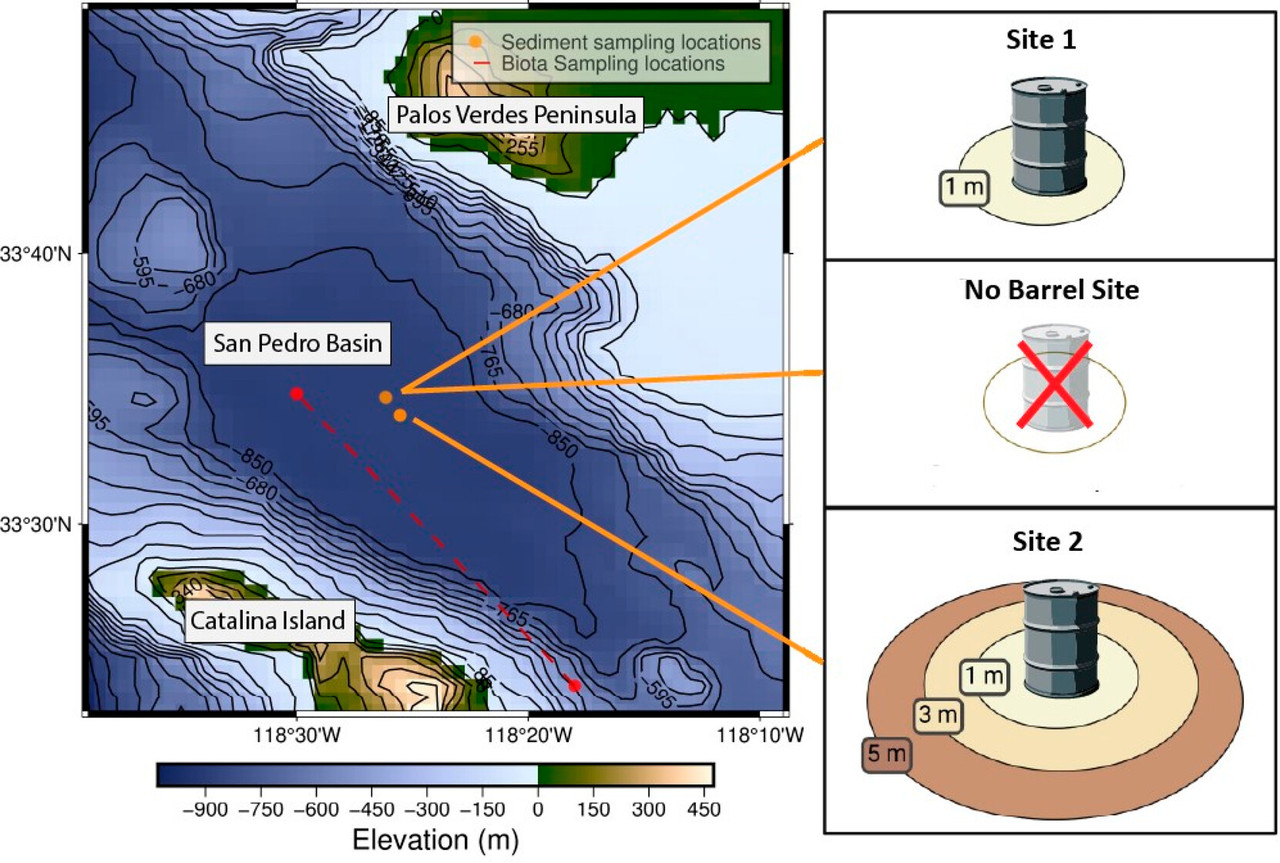
The caption:
Have a nice weekend.
 = new reply since forum marked as read
Highlight:
NoneDon't highlight anything
5 newestHighlight 5 most recent replies
= new reply since forum marked as read
Highlight:
NoneDon't highlight anything
5 newestHighlight 5 most recent replies

Faux pas
(16,266 posts)
